The Buxa Tiger Reserve with an area of 759 sq.kms was established in the
year of 1982-83 at the north eastern corner of West Bengal bordering Bhutan
and Assam. The core area of 315sq.kms around the Buxa Duar Fort was declared
a National Park in January 1992.
This park is located in eastern Dooars (rolling humid
plains) at 2600 ft above sea level. The Dooars comprises of deciduous
forests which are densely wooded and grasslands and is home to some of
West Bengal's most varied flora and fauna.
This tropical rain forests having an annual rainfall
exceeding 5000mm has 150 species of plants and a variety of creepers,
orchids, grasses, bamboo and cane. Trees like Teak, sal, simul, sishu
are found in great numbers.
 The
fauna of the park comprises 67 species of mammals, including 23 endangered
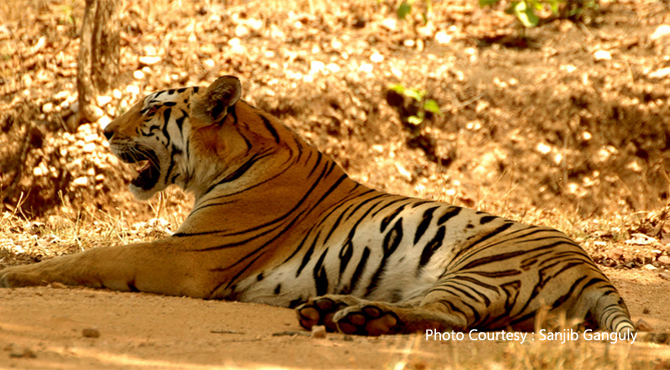
ones and 36 species of reptiles. Besides the Royal Bengal tiger the second
largest in number in West Bengal after Sunderbans, elephants, bears, civets,
giant squirrel, Gaur, Chital, clouded leopard, wild Buffaloes, antelope
and snakes including the regal Python are found here. About 230 species
of birds and innumerable butterflies add colour to the forest. The rivers
of Raidak and Jayanti which flow through the forest and the Narathali
lake are home to migratory birds as well as endemic ones which abound
the place. The Hornbills including greater Pied Hornbill, Ibis Bill,
Trans Himalayan Migratory Goosanders, Red-stars, Wag-tails, the rare black
necked crane, migratory common teal, black stork, Large Whistling Teal,
Minivets, White Eyed Poachared are some of the bird species sighted here. The
fauna of the park comprises 67 species of mammals, including 23 endangered
ones and 36 species of reptiles. Besides the Royal Bengal tiger the second
largest in number in West Bengal after Sunderbans, elephants, bears, civets,
giant squirrel, Gaur, Chital, clouded leopard, wild Buffaloes, antelope
and snakes including the regal Python are found here. About 230 species
of birds and innumerable butterflies add colour to the forest. The rivers
of Raidak and Jayanti which flow through the forest and the Narathali
lake are home to migratory birds as well as endemic ones which abound
the place. The Hornbills including greater Pied Hornbill, Ibis Bill,
Trans Himalayan Migratory Goosanders, Red-stars, Wag-tails, the rare black
necked crane, migratory common teal, black stork, Large Whistling Teal,
Minivets, White Eyed Poachared are some of the bird species sighted here.
The headquarters Alipurduar court is a few km away
from the tiger reserve. The two main entry points are Buxa (24km) and
Jayanti (30 Km). Buxa (2600ft) is a two hour trek through picturesque
surroundings from Santlabari, the starting point. The Buxa Duar fort here
was used as a prison by the British, because of its remoteness. Many freedom
fighters were imprisoned here. After independence, it served as
a refugee camp for Tibetans and Bangladeshis. There is a 4km further
trek to Rovers Point (the land of unknown birds at 4500ft) or a 14km trek
to Roopam Valley in Bhutan from Bhutan. From Buxa, one can also take the
13km trek to Jayanti through the beautiful jungle preferably with a guide.
There is a stalactite cave, popularly known as the Mahakal cave at Jayanti.
Another entry point Rajabhatkhawa (17km from Alipurduar) has an orchidarium,
animal rescue centre and a nature interpretation centre.
|



 Wildlife