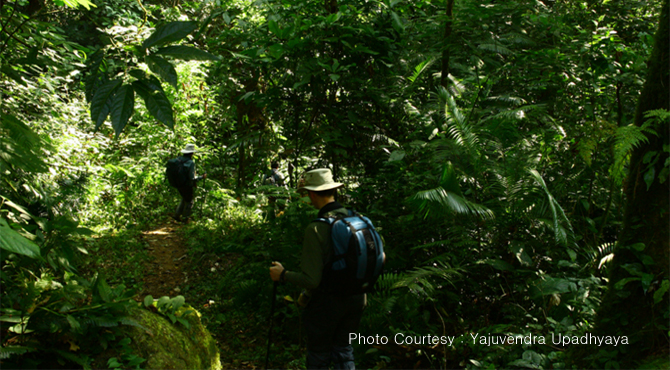
Namdapha National Park is located in the Changlang District of Arunachal
Pradesh on the India Burmese border a few km from the entry point, Miau.
It was designated as a National Park in 1983 under the Wildlife (Protection)
Act. The same year, it was also declared as tiger reserve under Project
Tiger. With a total area of 1985 sq kms, this is the largest national
park in the north-east and one of the larger protected areas in the country.
In fact, this was among the earliest national parks established in the
seven states of north-east India.
The park watered by the Noa- Dehing and the Namdapha
rivers, is largely inaccessible, with diverse habitats of flora and fauna.
The vegetation ranges from the wet evergreen tropical and sub-tropical
forests to temperate and alpine forests. A variety of wild tree species
and crop plants including banana, mango, citrus and medicinal and ornamental
plants including wild orchids are found here. The inaccessibility has
helped the forests to retain its pristine ness.
The fauna of the park comprises elephant, tiger, leopard,
snow leopard, clouded leopard, golden cat, wild dog, endangered Hoolock
gibbon, Namdapha Flying Squirrel, wild buffalo, guar, hog deer, sloth
bear, bison, Himalayan Tahr, Bharal, python, King cobra, , the wild goats;
takin peculiar to the Patkoi range, Serow and Goral etc. The park is rich
in bird life. The important birds are Indian Horn bill, the state bird
of Arunachal, white winged wood duck, cheer pheasants etc.
The park is unique in its altitude, which varies around
200 metres (nearly sea level) in the valleys to more than 4,500 metres
of snow covered mountain peaks. Perhaps no other national park in the
world can boast of such phenomenal altitudinal variation. The park is
also ideal for trekking and hiking. From Miau the entry point, a forest
road stretching over 28-km gives access to the protected area up to a
place called Deban where accommodation is available. You can make the
journey in a jeep or Gypsy. Beyond this there is no road and one has to
go on foot. It is a challenging trek through dense forests and steep hill
ranges with rivers flowing in between and the varying climatic conditions
from tropical to cold and temperate conditions.
|



 Wildlife