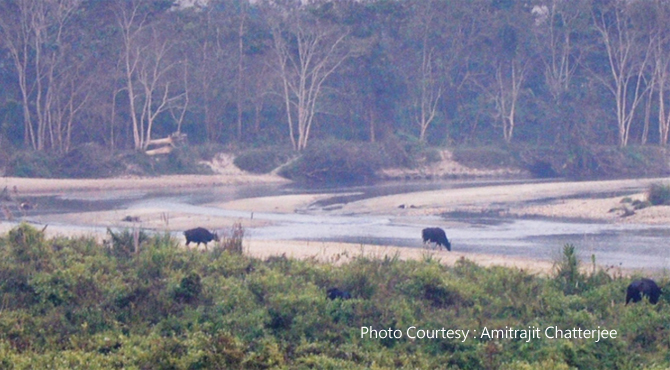
Gorumara National Park is located in the Dooars (rolling hill slopes)
region of Jalpaiguri district in West Bengal. This small forest area famous
for its natural population of the Great Indian one horned Rhinoceros was
declared a wildlife sanctuary in the year 1949. Later in the year
1992, it was established as a National Park, comprising 80 km of diverse
forests.
The dooars lying in the Himalayan foothills has great
natural beauty and is home to some of West Bengal's most varied flora
and fauna. Gorumara park located on the bank of rivers Murti and
Raidak has vegetation of riverine grasslands interspersed with savannah
woodlands. Much of this forest is moist deciduous and sal (shorea robusta)
is the most common and valuable tree. Teak, Simul, siris, Khair are also
found here. The park is breathtaking with its rivers and mountain ranges.
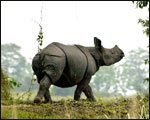 Besides
the one horned rhinoceros, the fauna of the park include Indian Elephant,
Indian Bison, leopard, different species of deer, turtles, pythons, monkeys
etc. and more than 200 species of birds. The park is a birdwatcher's
paradise with beautiful birds like Indian pied hornbill, Woodpeckers,
Sunbird, fly catcher, Minivet, Drongo, Pheasants and many more migratory
birds especially in winter. Brahmany duck is a regular visitor here and
the birds can be watched from Suksukia, a bird watching point inside the
park. Besides
the one horned rhinoceros, the fauna of the park include Indian Elephant,
Indian Bison, leopard, different species of deer, turtles, pythons, monkeys
etc. and more than 200 species of birds. The park is a birdwatcher's
paradise with beautiful birds like Indian pied hornbill, Woodpeckers,
Sunbird, fly catcher, Minivet, Drongo, Pheasants and many more migratory
birds especially in winter. Brahmany duck is a regular visitor here and
the birds can be watched from Suksukia, a bird watching point inside the
park.
Lataguri a small town adjacent to the park is the entry
point. There are watch towers for viewing the animals inside the park.
They are Jatraprasad Watch tower (named in memory of a legendary elephant
of that name), Rhino observation point in front of the Gorumara forest
bungalow, Old Khunia Watch Tower near the Murti forest bungalow and Suksukia
Bird watching Point. Rhino observation point is the best place to observe
wild animals like rhino, elephant, bison and deer as they regularly come
to the salt reservoir just below the tower. From Gorumara it is only a
two hours ride to Jaldapara wild life sanctuary which is also located
in the dooars.
|



 Wildlife