|
|

Friday, April 26, 2024
|
|


 Adventure Sports River Rafting Jammu and Kashmir Leh
|
| MAIN | HOW TO REACH |
Hotel
|
CONTACTS | |
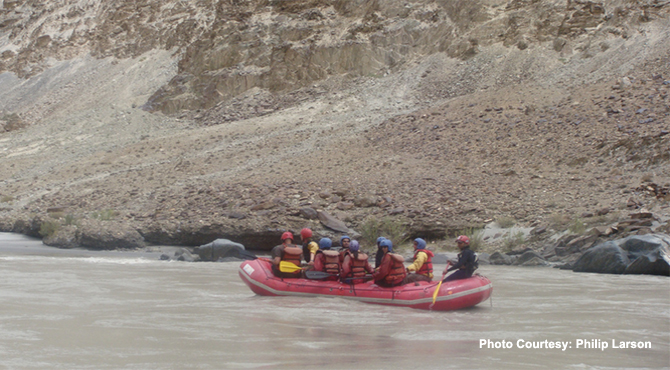
The Indus, having originated hundreds of kilometers further east from near the Kailash mountain and the Mansarovar lake in Tibet, enters India in the region of Skardu in Baltistan. While water levels are high, between the end of June and late August, travel agents in Leh, the capital of Ladakh offers many fascinating rafting expeditions lasting one or three-four days in the river. The best time to raft this river is during July - September when daily trips are organised. Indus river is one of the most scenic white water runs anywhere in the Himalayas. The view is breathtaking which takes one through the Canyons in the Ladakh and Zanskar ranges with various monasteries or gompas along the river bank.The icy cold and clear river have rapids generally of I and II grades and at some places, has grade III rapids.
Phey - Nemu route : The main attraction of the run, mostly with Grade II or III easy rapids is that it passes through astoundingly beautiful mountains, many of them with tiny villages and imposing old monasteries nestling among the valleys. The run starts at Phey and ends about 36 km from Leh, at Nemu. Upshi - Khalsey route : The Upshi-Khalsey run is somewhat long, but not too difficult. Most of the river along this stretch consists of grade I and II rapids, although there are some grade III rapids too. The run starts at Upshi, which lies upriver from Leh, along the road which leads south to Manali. From Upshi, the river makes its way westwards to Khalsey, along the road to Kargil.
Spituk - Karo : Upward of Spituk, the Indus has the easiest stretch up to Karu, ideal for basic training and for day-return 'scenic floating' for amateurs. |
NEARBY ATTRACTIONS |
|||||||||||||||||||||||||||||||||||||
|
|||||||||||||||||||||||||||||||||||||
|
|||||||||||||||||||||||
EXPLORE PLACES BY STATES |
||||||||||||||||||||||||||||||||||||||
|
||||||||||||||||||||||||||||||||||||||


 The Indus
river which lends India its name also known as the 'Lion River', flows
across the high altitude cold desert region of Ladakh in an almost straight
line from the north west to the south east, passes through the Leh valley
and flows into Pakistan.
The Indus
river which lends India its name also known as the 'Lion River', flows
across the high altitude cold desert region of Ladakh in an almost straight
line from the north west to the south east, passes through the Leh valley
and flows into Pakistan.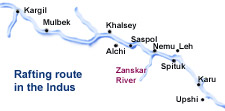 The
river offers most popular day trips from Phey to Nemu and also from Upshi
to Khaltsey or from Upshi to Nemu. There are also runs from Spituk to
Saspol or Spituk to the Indus Zanskar confluence at Nemu and from Nemu
to the ancient temple complex at Alchi. Experienced rafters may also want
to try the more challenging route between Alchi and Khalsey, which takes
in the kilometre long series of rapids at Nurla. Easier runs include the
run between Hemis (40km south of Leh) situated along a road crossing the
Indus and Choglamsar, which is a three-hour trip that goes through quiet,
calm waters, and passes through the riverside villages of Stakna, Shey
and Thikse (25km south of Leh), before ending at Choglamsar, just
short of Leh city.
The
river offers most popular day trips from Phey to Nemu and also from Upshi
to Khaltsey or from Upshi to Nemu. There are also runs from Spituk to
Saspol or Spituk to the Indus Zanskar confluence at Nemu and from Nemu
to the ancient temple complex at Alchi. Experienced rafters may also want
to try the more challenging route between Alchi and Khalsey, which takes
in the kilometre long series of rapids at Nurla. Easier runs include the
run between Hemis (40km south of Leh) situated along a road crossing the
Indus and Choglamsar, which is a three-hour trip that goes through quiet,
calm waters, and passes through the riverside villages of Stakna, Shey
and Thikse (25km south of Leh), before ending at Choglamsar, just
short of Leh city. 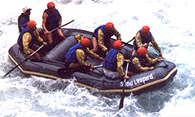 Spituk-
Saspol : Spituk, just short of Leh and on the bank of the Indus, is
the starting point for an easy and short trip downriver. The route goes
up to the village of Saspol, near Alchi, and comprises a run of a few
hours. A short and scenic run, the Spituk-Saspol route is relaxed enough
to allow you to admire the beauty of the Indus Valley; beyond Saspol,
however, the river starts getting a fraction wild, and is recommended
only for experts.
Spituk-
Saspol : Spituk, just short of Leh and on the bank of the Indus, is
the starting point for an easy and short trip downriver. The route goes
up to the village of Saspol, near Alchi, and comprises a run of a few
hours. A short and scenic run, the Spituk-Saspol route is relaxed enough
to allow you to admire the beauty of the Indus Valley; beyond Saspol,
however, the river starts getting a fraction wild, and is recommended
only for experts.
