Ganga or the Ganges is held in high esteem in Hindu ethics and is regarded
as the holiest of all rivers. Ganga Devi venerated as a goddess finds
mention in the holy book of the Hindus the Bhagavat Gita, the Puranas
and the epics Ramayana and Mahabharata. Hindus believe that a dip in the
holy Ganges redeems them of all sins. The perennial river traces its source
from the Bhagirathi river which originates from the Gangotri glacier at
Gaumukh (14000ft) located between the Bhagirathi and the Shivling peaks
of the Himalayas in northern Uttaranchal.
 The
Bhagirathi gushes through a small opening from under the glacier formed
of sheer icy walls 500 metres high on two sides and rock on one side.
The Bhagirathi joins with the Alakananda at the sacred town of Devprayag
to form the Ganga. From Devprayag the Ganga flows some 1,550 miles to
the Bay of Bengal and the vast Sundarbans Delta in West Bengal, passing
and giving life to some of the most populous cities of India, including
Kanpur, Allahabad, Varanasi, Patna and Kolkata. Ganga joins with the Brahmaputra
near Dacca, the capital of Bangladesh, to form the river Padma. The
Bhagirathi gushes through a small opening from under the glacier formed
of sheer icy walls 500 metres high on two sides and rock on one side.
The Bhagirathi joins with the Alakananda at the sacred town of Devprayag
to form the Ganga. From Devprayag the Ganga flows some 1,550 miles to
the Bay of Bengal and the vast Sundarbans Delta in West Bengal, passing
and giving life to some of the most populous cities of India, including
Kanpur, Allahabad, Varanasi, Patna and Kolkata. Ganga joins with the Brahmaputra
near Dacca, the capital of Bangladesh, to form the river Padma.
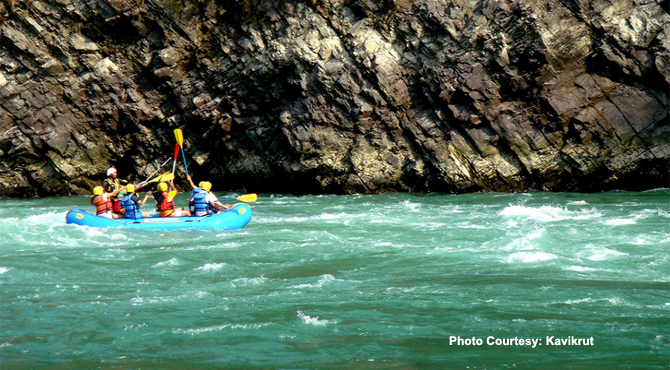
The Ganga and its tributaries such as Bhagirathi, Alakananda
and Mandakini, offers one of the most popular and adventurous river rafting
expeditions in the country. Ganga is full of surprises with its diversities
for the rafter, at some places it is calm and tranquil; while at others
it is equally turbulent and rapid. The best time to capture the thrill
of the Himalayan white waters is from February to April, and September
to December. Rishikesh near Shivpuri forms the base from where one can
participate in one of the many expeditions through the Ganga. Vehicles
can be hired from Rishikesh to the various starting points. There are
calm paced runs suitable for the amateur as well as expert professionals
with rapids as high as grade IV to V. The river runs through picturesque
surroundings with thick forested slopes of oak, pine, fir etc, occasional
villages with its terraced fields and sandy beaches at intervals suitable
for stop overs in between runs. Wild life can be sighted at a distance
along with Ashrams and spiritual retreats overlooking the river.
Rudraprayag to Rishikesh : One of the popular
but strenuous runs is the 150km run from Rudraprayag to Rishikesh. Rudraprayag
is situated at the confluence of the Alakananda and the glossy dark Mandakini
rivers, two of the main tributaries of the Ganga. The starting point is
situated a little further from the main town of Rudraprayag. It is a four
hour run from Rudraprayag to the town of Srinagar through calm stretches,
a series of rapids, boiling whirlpools and freezing temperatures. It is
dangerous when the water level is low, because sharp rocks at the surface
can rip a raft apart. The stretch from Srinagar to 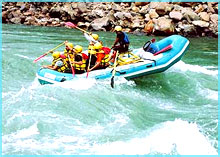 Devprayag
where the Bhagirathi and the Alakananda rivers meet and create the Ganga,
is rough. Between the thrashing rapids there are long stretches of flat
water. From Devprayag to Kaudiyala is another four hours calm ride where
rapids are scarce. From Kaudiyala, the stretch to Shivpuri which takes
5-6 hrs of rafting and on to Rishikesh is a fairly demanding one, with
the grade IV rapid called 'The Wall' at Byasi and the less graded huge
thrashing waves of rapids like the Roller Coaster (grade III), Clubhouse
and the Golf Course, 4km below Shivpuri village. The stretch around 70km
from Devprayag to Shivpuri is multigraded, but near the last sign post
ahead of Rishikesh the Ganga turns calm. The expedition takes about four
or five days depending on the pace. The run is picturesque through
the densely forested Himalayan foothills. There are regular buses to Rudraprayag
from Rishikesh and Haridwar. Devprayag
where the Bhagirathi and the Alakananda rivers meet and create the Ganga,
is rough. Between the thrashing rapids there are long stretches of flat
water. From Devprayag to Kaudiyala is another four hours calm ride where
rapids are scarce. From Kaudiyala, the stretch to Shivpuri which takes
5-6 hrs of rafting and on to Rishikesh is a fairly demanding one, with
the grade IV rapid called 'The Wall' at Byasi and the less graded huge
thrashing waves of rapids like the Roller Coaster (grade III), Clubhouse
and the Golf Course, 4km below Shivpuri village. The stretch around 70km
from Devprayag to Shivpuri is multigraded, but near the last sign post
ahead of Rishikesh the Ganga turns calm. The expedition takes about four
or five days depending on the pace. The run is picturesque through
the densely forested Himalayan foothills. There are regular buses to Rudraprayag
from Rishikesh and Haridwar.
Tehri to Shivpuri : This run starts at the Tehri town, the district
headquarters of the Tehri Garwal on the Bhagirathi river. The run goes
through rapids mostly Grade III- IV and reaches Devprayag. At Devprayag
The Bhagirathi merges with the Alakananda and the run is more calm and
manageable than the upper reaches till it reaches Kaudiyala. Then again
on to Shivpuri it is demanding with grade IV foaming rapids like the Wall
at Byasi and the Golf course, 4km below Shivpuri village. Details given
above in the Rudraprayag to Rishikesh run. Tehri is connected by buses
to Rishikesh, Haridwar and Dehradun.
Kaudiyala to Shivpuri: Kaudiyala is situated 28km
upstream from Rishikesh. The run from Kaudiyala to Shivpuri on the 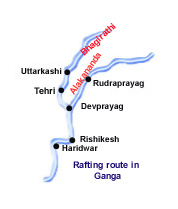 Alakananda
which takes 5-6 hrs of rafting is a fairly demanding one and passes through
thickly wooded hills, past riverside temples and two of the river’s
best rapids the 'Wall' and the the 'Golf course’- both graded IV
which are succeeded by deep, tranquil pools. There are several camping
sites in between the stretch. The run finishes at the dam beyond Rishikesh. Alakananda
which takes 5-6 hrs of rafting is a fairly demanding one and passes through
thickly wooded hills, past riverside temples and two of the river’s
best rapids the 'Wall' and the the 'Golf course’- both graded IV
which are succeeded by deep, tranquil pools. There are several camping
sites in between the stretch. The run finishes at the dam beyond Rishikesh.
Besides these routes, there are some other popular stretches
for rafting on the Ganga and its tributaries, like low graded Kaliasaur
to Srinagar (16km), Srinagar to Bagwan (20km)on the Alakananda river,
Multi graded Matli -Dunda (12km), Jnagla -Jhala(20km), Harsil - Uttarkashi(12km)
on the Bhagirathi river and High graded Chandrapuri - Rudraprayag
(26km) on the Mandakini river.
Ganga Rally
A three days rally in the ganga is organised in February every year
on a stretch linking Allahabad and Varanasi. The participants take off
in Kayaks, Canoes, rowing boats etc. The last leg of the rally, known
as Ganga Marathon is on a 40kms stretch from Chunar Fort (37kms from Varanasi)
to Rajendra Prasad Ghat in Varanasi. The prize of the Marathon is the
Benaras Cup Trophy.
|



 Adventure Sports