Chhatrapati Shivaji Terminus formerly Victoria Terminus with its cathedral
like facade is located at Dr. D.Naoroji Road, Nagar Chowk on the
eastern shoreline of Mumbai. Declared as a World Heritage Site by the
UNESCO on July 2, 2004, the train station is Mumbai's historical
landmark and also a symbol of the city's Gothic buildings. The Terminus
is the 2nd 'World Heritage Site' of the Indian Railways after the Darjeeling
Himalayan Railways which was inscribed in 1988, and the first functional
administrative building to be put on the World Heritage list.
Built in 1888 as the headquarters of the Great Indian Peninsular Railway
Company, Chhatrapati Shivaji Terminus is also the western most end point
of the Central Railways. Designed by Frederick William Stevens, a 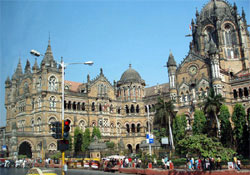 British
architect, the building is a wonderful example of the Indo-Victorian Gothic
Revival architectural style. The railway station was opened to the
public on New Year's Day, 1882. Today, at least 1250 trains leave the
station every day from its 14 platforms, carrying some 3.3 million
passengers in and out of the city. It is the hub of the suburban (local)
railways as well as some of the long distance trains. A major part of
the building houses the administrative section of the Central Railways. British
architect, the building is a wonderful example of the Indo-Victorian Gothic
Revival architectural style. The railway station was opened to the
public on New Year's Day, 1882. Today, at least 1250 trains leave the
station every day from its 14 platforms, carrying some 3.3 million
passengers in and out of the city. It is the hub of the suburban (local)
railways as well as some of the long distance trains. A major part of
the building houses the administrative section of the Central Railways.
Construction of the Terminus began in 1878 and was completed
after 10 years in May 1888 at a cost of Rs. 16.14 lakhs (Rs. 1.614 million). In
1853, it was from this station that India's very first steam engine left
for its first trip to Thane. Initially named as 'Victoria Terminus' in
honour of the reigning Queen Victoria, in 1996 it was renamed Chhatrapati
Shivaji Terminus honoring the great 17th century Maratha King, by the
State Government of Maharastra. It is now commonly known as CST though
the old name VT or Victoria Terminus, is still commonly used.
Built in local sandstone, with a combination of the English
Venetian Gothic style endorsed with elements of Indian Architecture, the
terminus interior is very impressive with vaulted roofs, arches, Gothic
spires, neoclassical sculptures, stone carvings, exquisite friezes etc. The
frontage of the terminus is symmetrical with a massive central dome and
a number of smaller domes and conical towers on the wings on either side.
The central dome bears a thirteen feet solid statue of
a woman ( 'Progress') with a flaming torch in her right arm raised towards
the sky and a spoked wheel low in her left hand, by Thomas Earp, an architectural
carver who also carved the Imperial lion and the Indian tiger on the gate
piers in the front. Beneath this dome are the stairs to each floor. A
life-size statue of Queen Victoria is placed in front of the central facade. The
other statues include one representing 'Agriculture' on the central gable
(triangular upper part of a wall at the end of a ridged roof) on the south
side and on each of the two gables in the wings of the west facade representing
'Engineering & Science' and 'Shipping & Commerce'. A large clock
of diameter 3.19 meters on the tower of the terminus is another attractive
feature. There are bas relief's of the 10 directors of the Great Indian
Peninsular Railway Company on the facade. Ornamented panels displaying
peacocks, monkeys, elephants and British lions are mixed up among the
buttresses, domes, turrets, spires and stained glass windows that are
rich in primary colours. There are four gateways to the main entrance
and the rectangular yard in front, maintains an ornamental garden on one
side.
The wood carving, tiles, ornamental iron and brass railings,
grills for the ticket offices, the balustrades for the grand staircases
and other ornaments etc were the work of students at the Bombay School
of Art. The cantilevered staircase that leads to the dome, the large
spacious booking hall with its pointed arcades, glazed tiles, stained
glass and wooden vaulted ceilings inspired by London's St. Pancras station,
the Star Chamber (the ticketing office for the local service) are fine
examples of art and engineering.
The increased traffic and pollution have damaged this
historic building's former glory, but the Central Railway has earmarked
a substantial amount for its restoration and conservation process. Some
additions and changes were made to the building as part of the expansion
and reorganisation of the Indian Railways in the 1960s and 1970s by the
Central Railways, mainly to accommodate an increasing staff strength.
But in 1980, as part of the conservation process the number of staff occupying
the building has been reduced.
|



 Monuments


