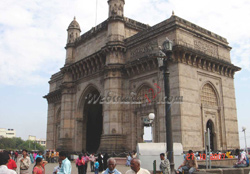
The Gateway of India, one of the majestic landmarks and the most photographed
monument in Mumbai city, was built to commemorate the visit of King
George V and Queen Mary to India in 1911. But the construction was
completed only years later after their visit.
 The
last British unit to leave India after it received Independence on August
1947, the Somerset Light Infantry, marched through the Gateway on 28th
February 1948, after taking part in a huge ceremonial Parade. A magnificent
silver replica of the Gateway of India was presented by the Army of India
to the battalion. The Gateway of India, located facing the harbour
of Mumbai, at the tip of the Apollo Bunder in the Colaba area in South
Mumbai, gives a magnificent view of the Arabian sea. Formerly, this colonial
historical structure, welcomed numerous Viceroys, Governors and top civil
servants to India. Today the domed basalt Archway serves as Mumbai's major
tourist center. The
last British unit to leave India after it received Independence on August
1947, the Somerset Light Infantry, marched through the Gateway on 28th
February 1948, after taking part in a huge ceremonial Parade. A magnificent
silver replica of the Gateway of India was presented by the Army of India
to the battalion. The Gateway of India, located facing the harbour
of Mumbai, at the tip of the Apollo Bunder in the Colaba area in South
Mumbai, gives a magnificent view of the Arabian sea. Formerly, this colonial
historical structure, welcomed numerous Viceroys, Governors and top civil
servants to India. Today the domed basalt Archway serves as Mumbai's major
tourist center.
The foundation of the Gateway of India was laid down
in March 31, 1911 by the then Governor of Bombay, Sir George Sydenham
Clarke. Designed by George Wittet, a Scotland architect, it's construction
was completed in 1924 AD and was opened to the public on December 4, 1924
by the Viceroy, the Earl of Reading.
Built in Indo-Saracenic style, the gateway has elements
of 16th century Muslim style of Gujarat, and is made of yellow Kharodi
basalt and reinforced concrete. The gateway has four towers and intricate
latticework engraved on the basalt. The central dome is 15 meters in diameter
and 26 meters to its apex. The total cost of the Gateway's construction
was Rs. 21 lakhs which was borne mainly by the Indian Government. The
whole harbour front was realigned to come in line with a planned esplanade
which was never built, due to a lack of funds, and so the Gateway now
stands at a curious angle to the road leading up to it.
There is a lawn in front, where people can relax and
watch hundreds of pigeons that flock together. The place is also a famous
Film shooting location. A beautiful statue of the Maratha leader Shivaji,
sitting on his horse, erected in 1960, and a statue of the social reformer
Swami Vivekananda, stand nearby.
Adjacent to the gateway, one can see India's first Five
Star hotel, Taj Mahal Palace hotel built in1903 by the Parsi Industrialist
J N Tata and designed by W Chambers. It is a magnificent structure that
exhibits Moorish influences and is crowned by a red-roofed dome. The original
structure has now been adjoined by a modern skyscraper, the Taj Mahal
Inter-Continental. Both have a splendid view east towards Elephanta Island
Just Behind the gateway, there are steps leading down
to the water. Always crowded, here boating facility is available. One can
hire little motor boats, for a short cruise through Mumbai's splendid
natural harbour, and for trips to the famous Elephanta
Caves. Boats leave from the Gateway all day.
|



 Monuments


