|
|

Friday, May 16, 2025
|
|


 Pilgrim Centers Churches Kerala Ernakulam
|
| MAIN | HOW TO REACH | HOTELS | CONTACTS | |
| The history of this ancient church reflects the colonial struggle of the European powers in India, from the15th through 20th century. The church was originally a wooden structure dedicated to St Bartholomew within the fort built in 1503, by the Portuguese who came with Admiral Pedro Alvarez de Cabral, following the tracks of Vasco da Gama who landed at Calicut in 1498. In AD 1506, the Portuguese Viceroy Dom Francisco Almedia was permitted by the Cochin Raja to reconstruct the buildings in stone masonry. Accordingly the wooden Church was refurbished presumably by the Franciscan friars with bricks and mortar and a tiled roof was erected. In 1516 A.D the new church was completed and it was dedicated to St.Antony. When the protestant Dutch captured Kochi in 1663, they converted it into their government church and made some renovations in AD 1779. The church was under the control of the Dutch until 1795 when the British captured Kochi from the Dutch. They permitted the Dutch to retain the church for sometime. In 1804, the Dutch voluntarily surrendered the church to the Anglican Communion when it was passed to Ecclesiastical Department of the Government of India. It is believed that the Anglicans changed the name of the patron saint to St. Francis.
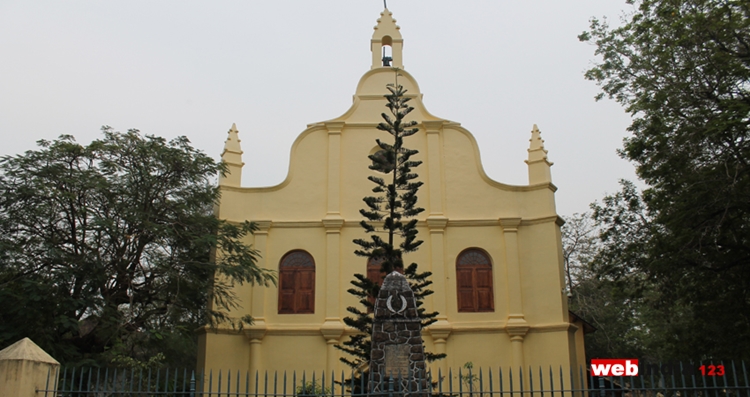
It is a lofty edifice with a gabled timber-framed roof covered with tiles. Facing the west, it has a semi-circular arched entrance and windows above. The facade is impressive, flanked on either side by a stepped pinnacle. There is a bell-turret on the summit of the gable-front, divided into three compartments. Inside the chancel is divided from the nave by a plain arched opening and the top of the chancel roof is crowned by two stepped pinnacles. It exhibits an architecture of arch. The interior of the church offer little apart from the tombs set into the walls and the floor. The gravestones of both Portuguese (on the northern sidewall) and Dutch (on the southern wall), with tales of deaths on distant shores, were taken from the floor of the grave in 1886. Vasco - Da - Gama the first European to discover a route to India, died in Kochi in 1524 on his 3rd visit and he was originally buried in this church. After 14 years his remains were removed to Lisbon in Portugal. The gravestone of Vasco - da - Gama can still be seen here. It is on the ground at the southern side. The Church possess an interesting link with the past in the form of the 'Doop Book', the old baptism and marriage register from 1751 - 1804 which may be seen in the vestry. It was maintained for 40 years in the handwriting of Predikant Cornelies and was sent to London in 1932 for the leaves to be repaired by experts. It was then rebound in the original style. A Photostat copy takes the place of the original for scrutiny by visitors. The clock on this Church was erected in the year 1923 in memory of Hal Harrison Jones, a former Managing Director of Aspinwall and Company. The hand operated Pankhas or Fans found in the church are a remainder of the British opulence of that period. A few memorial brass plates and marble slabs were erected in memory of very important persons who had dedicated their own lives to this Church and the society. Some of the heraldic designs and armorial bearings on the tomb-stones, affixed on the walls of this church are examples of fine workmanship. The earliest Portuguese epitaph here dates back to1562, while that of Dutch to 1664. The present furniture were installed when it was under the Anglican order of worship. Now the church is a protected monument under the Central archaeological Survey f India but is owned by the North Kerala diocese of Church of South India (CSI). There is regular worship services in this church on all Sundays and commemorative days. On weekdays it is kept open for visitors and tourists. Open from sunrise to sunset. Mass Schedule: The Sunday service is at 0800 hrs, except the 3rd Sunday of each month. |
VIDEO OF ST. FRANCIS CHURCH |
|
|
NEARBY ATTRACTIONS |
|||||||||||||||||||||||||||||||||||||
|
|||||||||||||||||||||||||||||||||||||
|
|||||||||||||||||||||||||||||||||||
EXPLORE PLACES BY STATES |
||||||||||||||||||||||||||||||||||||||
|
||||||||||||||||||||||||||||||||||||||


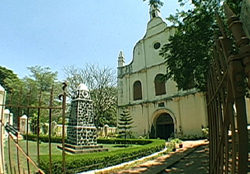 St.
Francis Church, originally dedicated to Santo Antonio, the patron Saint
of Portugal, is the first European Church in India. Situated at Parade
Road, 2 Km west of Mattancherry in Fort Cochin, this church is a living
historical monument and one of the main tourist attractions in Fort Kochi.
St.
Francis Church, originally dedicated to Santo Antonio, the patron Saint
of Portugal, is the first European Church in India. Situated at Parade
Road, 2 Km west of Mattancherry in Fort Cochin, this church is a living
historical monument and one of the main tourist attractions in Fort Kochi.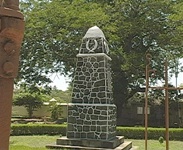 The
church became a protected monument in April 1923 under the Protected Monuments
Act of 1904. The Cenotaph in memory of the residents of Cochin who fell
in the First Great War was erected in 1920 and was unveiled by the Governor
of Madras on 21st October of that year. The boundary walls were erected
in 1924. In 1947, the congregation joined the Protestant Church of South
India (CSI).
The
church became a protected monument in April 1923 under the Protected Monuments
Act of 1904. The Cenotaph in memory of the residents of Cochin who fell
in the First Great War was erected in 1920 and was unveiled by the Governor
of Madras on 21st October of that year. The boundary walls were erected
in 1924. In 1947, the congregation joined the Protestant Church of South
India (CSI).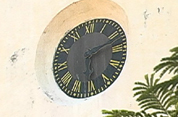 Being a modest unpretentious structure, it has no particular architectural
merit, but it stands as a land mark of history and church architecture
of India. Numerous churches has been built on the Indian soil keeping
the St. Francis church as the model. It has been raised on a plan similar
to the earlier types prevalent in Kerala though in elevation it has discarded
the idea of dominating tower over the chancel.
Being a modest unpretentious structure, it has no particular architectural
merit, but it stands as a land mark of history and church architecture
of India. Numerous churches has been built on the Indian soil keeping
the St. Francis church as the model. It has been raised on a plan similar
to the earlier types prevalent in Kerala though in elevation it has discarded
the idea of dominating tower over the chancel.
