 Also
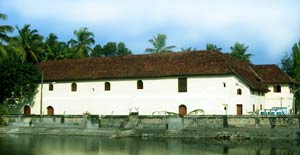
known as Dutch Palace, the Mattancherry palace with its medieval
charm is situated at Palace Road, Mattancherry,10km from Ernakulam city,
Kochi, Kerala. Built by the Portuguese and presented to the Raja of Kochi Veera
Kerala Varma (1537-65) in 1555 AD, it took on its present popular name
'Dutch Palace' after 1663, when the Dutch carried out some extensions
and renovations in the palace. The rajas also made more improvements to
it. Today, it is a portrait gallery of the Cochin Rajas and notable for
some of the best mythological murals in India, which are in the best traditions
of Hindu Temple Art. Also
known as Dutch Palace, the Mattancherry palace with its medieval
charm is situated at Palace Road, Mattancherry,10km from Ernakulam city,
Kochi, Kerala. Built by the Portuguese and presented to the Raja of Kochi Veera
Kerala Varma (1537-65) in 1555 AD, it took on its present popular name
'Dutch Palace' after 1663, when the Dutch carried out some extensions
and renovations in the palace. The rajas also made more improvements to
it. Today, it is a portrait gallery of the Cochin Rajas and notable for
some of the best mythological murals in India, which are in the best traditions
of Hindu Temple Art.
The entrance to the Mattancherry Palace compound is through
two arches which are typically Portuguese in character and a flight of
steps through a portico on the south, gives access to a suite of public
rooms on the upper level of the palace. The Palace with two floors built
around a central courtyard follows the traditional Kerala style of architecture
known as 'nalukettus'. From the outside, the palace looks European in
character with scraped masonry walls and round-headed windows and doors
but its sloping tiled roof and wooden balconies are indigenous features.
Inside the inner court, there stands a small temple
dedicated to 'Pazhayannur Bhagavati', the protective goddess of the Kochi
Royal family. Two more temples are situated on either side of the Palace
dedicated to Lord Krishna and Lord Siva. The palace, with the interiors
panelled with wood has exhibits of the Rajas of Kochi like ceremonial
robes, headdresses, weapons, palanquins, furniture but the main feature
is the series of astonishing murals, depicting scenes from the Ramayana,
the Mahabharata, and the Puranic legends connected with
Shiva, Vishnu, Krishna, Kumara, and Durga painted on the walls
as well as the portraits of the rajas. The paintings cover a wide range
of themes from the 'Puthra Kameshti Yagam' to Rama's return to Ayodya
after vanquishing King Ravana of Lanka. The paintings totally cover nearly
1000 sq.ft in area and date from early as the 16th century through mid
nineteenth century and are found in the bedchambers on the west side of
the palace, in four chambers upstairs, and in two low ceiling rooms that
are entered by a steep stairway. These beautiful and extensive paintings
are fine examples of Kerala mural paintings best known for its unique
style than the technique.
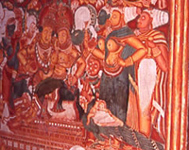 The
king's bedchamber or 'Palliyara' left of the entrance occupying the southwest
corner of the Palace is noteworthy with its low wooden ceiling and
300 sq feet of wall surface covered in about 48 paintings illustrating
the Ramayana, from the beginning of the sacrifice of Dasaratha to Sita's
return from captivity in Lanka. These paintings are the earliest in the
palace, dating as early as 16th century. The last five scenes are from
the 'Krishna Lila' where in a cheerful God Krishna using his six hands
and two feet to engage in foreplay with eight happy milkmaids. Another
important series of paintings in the Dutch Palace is found in the upper
staircase rooms, notably that of the coronation hall that was made under
Dutch patronage. Among the compositions are
Lakshmi seated on the lotus, sleeping Vishnu (Ananthasayanamurti),
Shiva and
Parvati seated with Ardhanariswara and other goddesses, the
coronation of Rama, Krishna lifting Mount Govardhana etc. On the opposite
side of the coronation hall is the staircase room or Kovinithalam (Room
No II) , with a descent to the lower storey and four paintings belonging
to Shiva, Vishnu and Devi, one incomplete. The ladies chambers below
the stairway are closed off to visitors. Room No. IV depict scenes from
Kumarasambhavam and other works of the great Sanskrit poet Kalidasa. The
king's bedchamber or 'Palliyara' left of the entrance occupying the southwest
corner of the Palace is noteworthy with its low wooden ceiling and
300 sq feet of wall surface covered in about 48 paintings illustrating
the Ramayana, from the beginning of the sacrifice of Dasaratha to Sita's
return from captivity in Lanka. These paintings are the earliest in the
palace, dating as early as 16th century. The last five scenes are from
the 'Krishna Lila' where in a cheerful God Krishna using his six hands
and two feet to engage in foreplay with eight happy milkmaids. Another
important series of paintings in the Dutch Palace is found in the upper
staircase rooms, notably that of the coronation hall that was made under
Dutch patronage. Among the compositions are
Lakshmi seated on the lotus, sleeping Vishnu (Ananthasayanamurti),
Shiva and
Parvati seated with Ardhanariswara and other goddesses, the
coronation of Rama, Krishna lifting Mount Govardhana etc. On the opposite
side of the coronation hall is the staircase room or Kovinithalam (Room
No II) , with a descent to the lower storey and four paintings belonging
to Shiva, Vishnu and Devi, one incomplete. The ladies chambers below
the stairway are closed off to visitors. Room No. IV depict scenes from
Kumarasambhavam and other works of the great Sanskrit poet Kalidasa.
The eastern rectangular chambers across the rosewood
covered main hall is entered through a steep stairway and an entrance
porch with finely carved and painted ceiling. The first of the eastern
chambers is marked by fabulous scenes of Vishnu and Siva iconography and
just beyond it to the left is a small room with an unfinished but bold
image of Vishnu as 'Vaikunthanatha'. These are among the latest works
in the palace. The Dining Hall has carved wooden ornate ceiling decorated
with a series of brass cups. The palace also contains rare examples of
traditional Kerala flooring, which looks like polished black marble but
is actually a mixture of burned coconut shells, charcoal, lime, plant
juices and egg whites.
Adjacent to the palace, almost within its grounds is
the famous Cochin synagogue built in 1567 and between them stands a large
circular temple with a cone roof which is not open to non- Hindus.
|



 Monuments


