|
|

Wednesday, August 27, 2025
|
|


 Monuments Forts Maharashtra Raigad
|
| MAIN | HOW TO REACH | HOTELS | CONTACTS | |
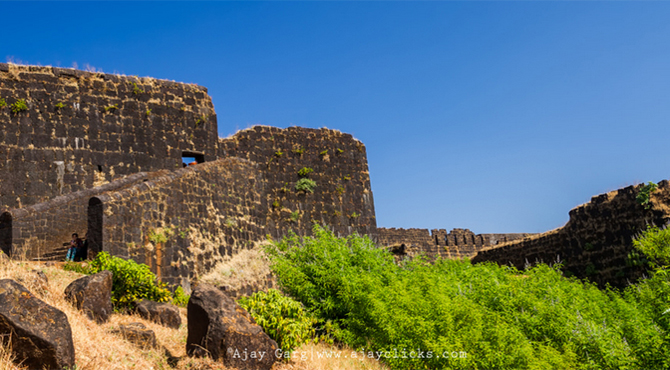
| Separated from the main peak of the Sahyadri mountain range by a deep valley on the east, the climb of 1400–1450 steps needed to reach the top of the fort. Under the name of Raiiri, this fort was successively under the rulers Brahmanis and Nizam Shahis.The Nizam Shahi Dynasty held it until 1626 when it was hand over to the Adil Shah's of Bijapur. Shivaji captured Rairi in 1656 and renovated and expanded it. This causes to emerge the Konkan routes also. For the extension of Maratha power Shivaji selected Rairi as his new capital in 1672, renaming it as Raigad Fort. Two years later Shivaji made Raigad as his seat of government. In June 1674, Shivaji chose it for his coronation at the hands of Brhahmin priests. He was crowned here with much splendour as Chhatrapati, 'Lord of the Umbrella'. After 6 years later, Shivaji breathed his last here, on 3rd April 1680. In 1689 the Aurangazeb acquired the citadel. But it thereafter handed over to the Sidis, with orders to defend it against the Martathas. In spite of repeated attempts, the Marathas were unable to retake Raigad untill 1743. The fort remained in Maratha hands untill 1818, when it was captured by the British. In 1885, Sir Richard Temple, the Governor of Bombay visited Raigad and saw the decaying condition of the Samadhi of Shivaji. He, then ordered the restoration of some of its buildings. In 1869, the great social reformer Mahatma Jyotiba Phule initiated an annual ceremony to commemorate Shivaji's death. The hilltop is approx 2,500m long and 1,500 m at the widest central point. The fortifications are built of massive basalt blocks reinforced by round bastions. A bastioned wall encloses and two outer curtain walls curve round the hillsides 60m and 120 m below. Each of the three corners of this irregular triangle are heavily fortified which offeres fine panoramas. In Shivaji's period, the fort was regarded as one of the strongest in India. The main gate the Maha Darwasa is flanked by two ruined towers with multiple tiers stand outside the walls, both 21 m high, one concave and the other convex. Inside the fort, houses several buildings. Mena Darwaja was the special entrance for the royal ladies and the queens. To the left of Mena Darwaja, is the Queens Chambers consisting of six chambers. This were used by Jeeja Bai (Shivaj's mother), Soyarabai, Putalabai and other royal ladies. In front of this is the Palkhi Darwaja, a special entrance to the Palaces for the King travelling in Palanquins a great honour in those days. On the right side of Mena Darwaja, is the office complex of 8 principal secretaries of Shivaji Maharaj. To the right of Palkhi Darwaja, there is a row of three dark chambers. One can see, a circular Ganga Sagar, Raigad's chief reservoir in the fort. Palace of Shivaji known as Raj Bhavan is situated between the Gangasagar and Kushwatra tanks. An arched entrance in the walls leads to long flight of steps which ascends to a passageway. The palace which was constructed of wood stands on a double plinth. Adjoining this, is two large water tanks. To the east of Raj Bhavan, there is a courtyard where there is an underground cellar where the throne of Chattrapati stood when he was crowned and assumed the title Chattrapati. A statue of his can also be seen here. Further north is the two row market place, the Jagdishwar Temple. Near to this, is the Samadhi of Chhatrapati Shivaji, behind which one can see the statue of a dog (Waghya- Shivaji’s faithful dog) on a pedestal. |
||
NEARBY ATTRACTIONS |
|||||||||||||||||||||||||||||||||||||
|
|||||||||||||||||||||||||||||||||||||
|
|||||||||||||||||||||||||||||||||||
EXPLORE PLACES BY STATES |
||||||||||||||||||||||||||||||||||||||
|
||||||||||||||||||||||||||||||||||||||