|
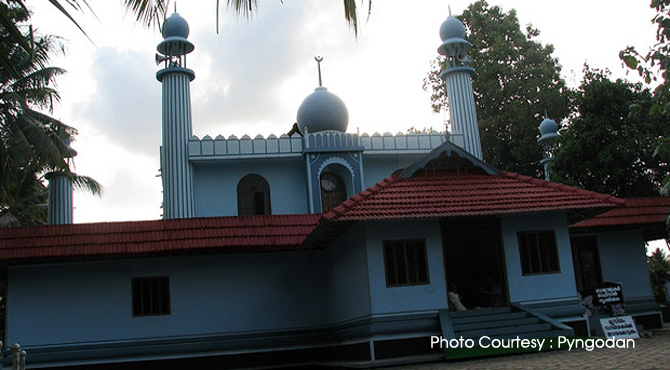
Believed to be the first mosque in India, Cheraman Juma Masjid where the
Juma prayers were started is situated in Methala Village of Kodungalloor
taluk in the state of Kerala. Built around 629 AD, the mosque is unique
in its appearance as it is based on a mixture of Arab and traditional
Kerala art and architecture.
The Oral tradition is that the Arab world had trade contacts
with Kerala coast from very early times. Interaction with the Arabs brought
Cheraman Perumal(the last Chera king to rule Cheranad (ancient Kerala))
closer to Islam. Later the king partitioned his kingdom among several
chieftains for smooth governance, went to Mecca and converted to Islam
and accepted the name Thajuddin. He married the sister of King of Jeddah
and settled down there. As the tradition goes, Cheramanperumal, when he
was convinced of his imminent death, wrote letters to his relatives in
Kerala seeking their help to propagate the tenets of Islam in Kerala.
After his death, when Malik Bin Dinar (a disciple of Prophet Mohammed
and a contemporary of Cheraman Perumal) came to Kerala, he brought the
letters written by Perumal. The rulers of Kerala honoured the letter and
permitted Malik Bin Dinar and his fellow Arab Muslim traders to establish
mosques at different places in Kerala. This mosque at Kodungallur was
the first to be established and Malik Bin Dinar himself became the first
Ghazi of the mosque. Later Malik Bin Dinar appointed his son Habib Bin
Malik as the next Ghazi, travelled all around Kerala establishing mosques
in different parts of the state.
Kerala Vyasan Kunjukuttan Thampuran is of the opinion
that an old Buddha temple was handed over to the Muslims to establish
a mosque there. It is believed that the mosque was first renovated or
reconstructed sometime in the 11th century AD and again 300 years ago.
The last renovation was done in 1974 as a result of increase in the population
of the believers an extension was constructed demolishing the front part
of the mosque. The older part of the mosque including the sanctum sanctorum
was left untouched and is still preserved. Extensions were again made
in 1994 and 2001. The wooden interior of the ancient mosque remains intact
but the exterior was changed completely. The facade now has concrete
minarets.
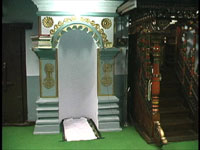 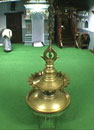 Built
in the Indo-Saracenic style of architecture, the Cheraman mosque has finely
crafted woodwork especially in the pulpit, and uses a traditional Kerala
brass oil lamp, mostly found in Hindu temples. There is an ancient ceremonial
pond near the mosque which is still intact. It is believed that
the old two tombs, seen here belongs to Habib Bin Malik, son of Malik
Bin Dinar, and his wife Khumarriah. A block of white marble in the mosque
is believed to have been brought from Mecca. Built
in the Indo-Saracenic style of architecture, the Cheraman mosque has finely
crafted woodwork especially in the pulpit, and uses a traditional Kerala
brass oil lamp, mostly found in Hindu temples. There is an ancient ceremonial
pond near the mosque which is still intact. It is believed that
the old two tombs, seen here belongs to Habib Bin Malik, son of Malik
Bin Dinar, and his wife Khumarriah. A block of white marble in the mosque
is believed to have been brought from Mecca.
Devotees in large numbers visit the mosque especially
during Ramzan, and they include pilgrims from different communities. Perhaps
this is the only mosque where 'Vidyarambham' is performed on the Vijaya
Dasami day and many non- Muslim devotees initiate their children into
the world of literacy at the mosque. Women are not allowed into the mosque
at any time. The mosque is managed by a Mahallu Committee elected as per
the by laws, consisting of only adult members for a period of two years.
There are many historical places in the vicinity of the
mosque. The old palace of the Chera kings and a Mahadeva temple is just
250 metres away from the mosque. The famous Kodungallur Bhagavathy temple
is 2km away and the site where St. Thomas landed in 52 AD is around 5
km away from the mosque.
|



 Pilgrim Centers