|
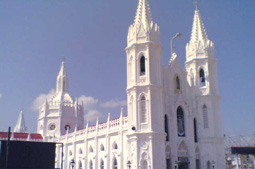 Velankanni is located 12 km south of Nagapattinam on the Coromandel Coast,
in Tamil Nadu. The shrine here is dedicated to Our Lady of Health, the
Madonna of Velankanni and is popularly known as 'Sacred Arogya Matha Church'.
Virgin Mary is believed to have miraculous healing powers. Thousands of
pilgrims belonging to various castes and communities flock daily to this
'Lourdes of the East'. The church has an imposing facade with tall spires
and the wings present the shape of a cross. In a niche in the alter is
enshrined the statue of Our Lady of Health.
Velankanni is located 12 km south of Nagapattinam on the Coromandel Coast,
in Tamil Nadu. The shrine here is dedicated to Our Lady of Health, the
Madonna of Velankanni and is popularly known as 'Sacred Arogya Matha Church'.
Virgin Mary is believed to have miraculous healing powers. Thousands of
pilgrims belonging to various castes and communities flock daily to this
'Lourdes of the East'. The church has an imposing facade with tall spires
and the wings present the shape of a cross. In a niche in the alter is
enshrined the statue of Our Lady of Health.
In 1560, Virgin Mary is said to have appeared to a shepherd,
asking him for milk to quench the thirst of baby Jesus. When the shepherd
returned to his master, after performing the good deed, his pitcher kept
filling up with milk. Consequently, a small thatched chapel was built
at the site. At the end of the 16th century, Virgin Mary appeared again
in front of a lame boy, who regained the use of his limbs. The actual
church was constructed after the incident.
The tradition is to offer Our Lady of Health, a candle
in the shape of the respective ailment- a heart in case of cardiac complications,
a liver in case of jaundice, lungs in case of tuberculosis and so on.
In case of the ailment getting cured, many bring with them small gold
and silver replicas of parts of the body that has been cured to donate
to the church.
Some times offering are sent in sealed bottles or big
hollow bamboos duly closed and thrown in to the sea with the address
of the shrine written on them. Such offerings are believed to reach
the holy spot. There is a small church museum which has a display of the
offerings made by those whose prayers were conceded.
A festival is celebrated for ten days from August 28
to September 10 every year and pilgrims from all over the country
and even abroad flock to the site, bathe religiously in the sea, have
their heads shaved and then walk on their knees or roll up to the shrine
as rituals.
|



 Pilgrim Centers


