 This
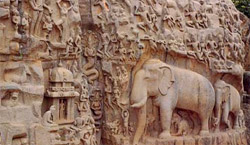
marvel sculptured in rock is located at Mamallapuram, 58 km from Chennai,
the capital of Tamil Nadu in Southern India. Approximately 96ft long and
43 ft high, carved in mid seventh century on the face of two enormous
adjacent boulders, this is one of the biggest open-air rock sculptures
in the world. This
marvel sculptured in rock is located at Mamallapuram, 58 km from Chennai,
the capital of Tamil Nadu in Southern India. Approximately 96ft long and
43 ft high, carved in mid seventh century on the face of two enormous
adjacent boulders, this is one of the biggest open-air rock sculptures
in the world.
Mamallapuram, once the ancient port of the Pallava dynasty
who traded with countries of the far east, is now world famous for the
splendid 7th and 8th century art and architecture
of the period. Its monolithic rock sculptures, carvings, shore temple
and wonderful beaches make the place a beautiful tourist destination.
The skillfully carved edifice is named after the Epic
Mahabharatha hero, Arjuna. The subject is either an account from the Epic
Mahabharata, of how Arjuna, one of the Pandava brothers, performed severe
austerities in order to obtain Shiva's weapon to destroy his enemies OR
an illustration of King Bhagiratha's penance to bring the River Ganges
down to earth to purify the souls of his ancestors. His prayers are answered
and Lord Shiva sends the Ganges down to earth, but breaks her fall by
allowing the water to trickle through his hair, so that the impact of
its fall would not harm the earth. This strange sight is said to have
aroused the curiosity of the world's animals, which gathered around the
soaking God. The symbolism of the relief supports both these stories.
Some of the popular fables from the Hindu Panchatantra books are also
depicted.
Mammallapuram
Dance Festival |
The vibrant festival of dance
is held annualy in Mamallapuram from early January for four
weeks. |
|
| |
|
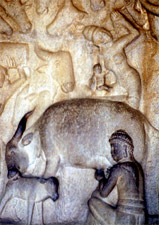 The sculptured figures on rock are remarkable for its vitality and
naturalism and the skill with which they are sculpted. There are
over 100 figures of gods and flying celestial creatures, birds and
animals including giant elephants, human beings and saints in this
beautifully sculpted scenario.
The sculptured figures on rock are remarkable for its vitality and
naturalism and the skill with which they are sculpted. There are
over 100 figures of gods and flying celestial creatures, birds and
animals including giant elephants, human beings and saints in this
beautifully sculpted scenario.
There is a natural cleft between the two rocks
separating the relief into two halves. The descent of the celestial
river is represented by this cleft. Most of the figures of animals
and celestial beings are carved either facing or approaching this
cleft and generally with hands folded in adoration. The cleft is
filled with a slab sculpted with male and female nagas (snakes),
their hands held together in adoration, over which a contrived waterfall
is fed from a collecting chamber above. On the left side of
the cleft there is a four-armed deity, probably Shiva, his right
hand holding a weapon, the left hand the showing the gesture for
granting a blessing and attended by dwarf ganas (guards and followers
of Lord Shiva). Just right to this deity of Shiva, a little below
Arjuna OR Bhagiratha stands on one leg, with arms upraised, in a
yoga posture seeking his blessing. Beneath this figure is a small
simple shrine of Lord Vishnu in front of which sit sages, a buck
and his doe and a lion and disciples engaged in austerities. A few
animals are seen resting in their caves to the left. But the remaining
lower left portion of this boulder is left un-carved. The Upper
left portion of this boulder represents a mountain probably Shiva's
abode in the Himalayas, where gods and animals are seen blended
together.
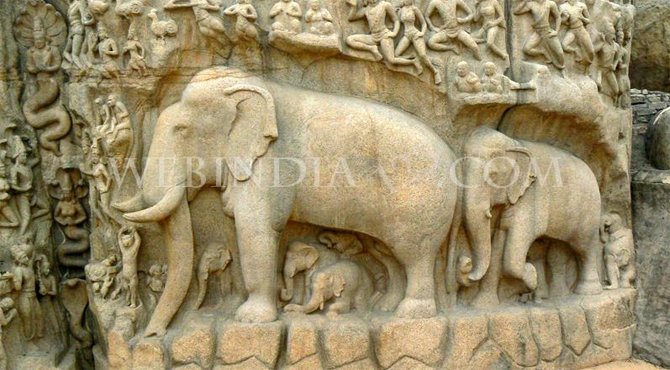
To the right of the cleft in the other boulder
are seen numerous celestial beings and animals of which the most
remarkable are the life-sized elephants protecting their young.
Beneath the elephants there are scenes from the Panchatantra fables,
such as the story of the cat doing penance by standing on one leg,
trying to trick a group of rats.
Just right of this exquisite relief, on a low platform,
a group of carved monkeys are seen preening one another and playing
and nursing a baby, which is also remarkable. |
|



 Monuments