|
|

Thursday, April 25, 2024
|
|


 Monuments Forts Madhya Pradesh Gwalior
|
| MAIN | HOW TO REACH | HOTELS | CONTACTS | |
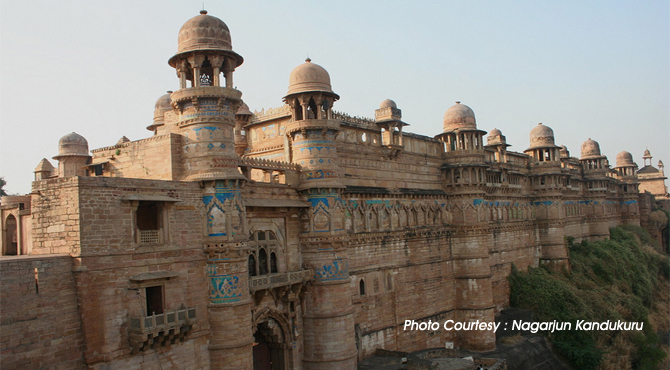
From the British the fort finally went to its former masters, the Scindia's when India became independent. The fort has been a mute witness to many historical battles and events- one of the most important among them being the1857 revolt, as well as the valiant death of Rani of Jhansi, (Rani Laxmibai) in1858 within its ramparts while fighting against the British. This magnificent fort with two main entrances, encloses three complexes, six palaces, temples and a number of water tanks. Inside the fort there are some wonders of medieval architecture, including temples such as Teli-ka-Mandir (8-11th century AD) and Sas Bahu ka Mandir (11th century), palaces like Gujari Mahal (16th century) and Man Mandir Palace (15th century) and Suraj Kund, an 8th century AD water tank where the Rajput chieftain Suraj Sen or Suraj Pal who founded the Gwalior city, is believed to have been cured of a deadly disease after drinking from the pond at the direction of Saint Gwalipa in whose name the city is named. Of the two main entrances to the fort, one is in the North East and other is in the South West. On either sides of the access road to the south west entrance- the Urbai Gate, are statues of Jain thirthankaras dating back to the 8th and the15th centuries, some up to 20m tall. The figures were defaced by the forces of Babur in 1527 but were later restored. The images are classified into five main groups. The Arwahi group contains a 17m high standing sculpture of the first Jain thirthankar, Adinath and a 10m high seated figure of Nemnath, the 22nd Jain thirthankar. The south -eastern group is the most important and covers nearly 1 km of the cliff face with more than 20 images. The north eastern entrance to the fort, accessible through worn out steps cut out of the rock, has six gates. The approach starts from the State Archaeological Museum and leads to the Man Mandir palace. The six gateways in between include the Gwalior or Alamgiri Gate built in 1660, named after Emperor Aurangazeb; Badalgarh or Hindola gate, a fine example of Hindu architecture named after Man Singh's uncle, Raja Badal Singh Tomar; the third gate, Bhairon no longer exists; the fourth gate Ganesh has a Kabuthar Khana (Pigeon House), a small tank and a shrine of Saint Gwalipa after whom Gwalior city is named, Laxman gate built in the14th century (876 AD) has the Vishnu Chaturbhuja or Four-Armed temple nearby, believed to be the oldest temple in Gwalior. The last gate, Hatia Paur or elephant gate built in 1516, is the entrance to the main Man Mandir palace. Another gateway, the Hawa Gate which stood within the palace has been demolished. The tallest structure in the fort, the 100 ft high Teli-ka-Mandir (oil man's temple) dates back to the 9th century, and is the most impressive of all the temples in the Gwalior fort. Constructed by the Pratihar Rajas, this Vishnu temple is an amalgamation of the Dravidian (from South India ) and the Indo-Aryan (North Indian) architectural styles. The roof is typically Dravidian but the sculptures and embellishing inside are Indo Aryan in nature. The10m high doorway has a Garuda statue on top. The larger one among the two, was built by Mahipala, a Kachhwaha Rajput Prince of Gwalior in 1093 A.D. The temple several stories high, is balanced solely with the help of beams and pillars without arches. The doorways, ceilings and four huge pillars are sculpted with graceful figures and intricate patterns. The temple has an ornately carved base and the ceiling is an impressively carved dome. The smaller temple, widely recognised as that of the Bahu, more elegant in appearance than the greater Sas-bahu temple consists of an open-sided porch with a pyramidal roof. Between the Teli Ka Mandir and the Sasbahu Temple there is the historic Gurudwara Data Bandhi Chhod built in memory of Guru Hargobind Sahib, the 6th Sikh Guru. Completely made of white marble, the Gurudwara is decorated with color glasses with cupolas on domes made of gold. The Man Mandir Palace approached via the north eastern fort entrance, is the most impressive building in the Gwalior fort. It was built by Raja Man Singh of the Tomar dynasty between 1486 and 1516 and was later repaired in 1881. The palace is also known as the Chit Mandir or Painted Palace for its richly tiled and painted decorations with elephants and peacocks, and the exceptional fresco with the ducks paddling in turquoise waters. The now deserted palace has four storeys, two of them underground. Rooms are spacious but bare, some of them with fine screens used for musical concerts where behind these screens, the royal ladies used to listen to concerts and learn music. Below the palace, there are circular underground cells used as a prison during the Mughal Period. Emperor Aurangazeb imprisoned his brother Murad and later executed him here. The Sikh guru Har Gobind was also imprisoned here for two years. Near by is the 'Jauhar Pond', where the Rani's (queens) committed 'mass sati' or self-immolation, after their husbands were defeated in battle, following the Rajput tradition. Other palaces within the Gwalior Fort which are worth seeing include the Vikramaditya Mahal, Karan Mandir or Kirti Mandir palace, the Jahangir Mahal, the Shahjahan Mahal and the Gujari Mahal. Built in 1516, the Vikramaditya Mahal with a domed roof lies between Man Mandir and Karan Mandir and narrow galleries connect these palaces. Karan or Kirti Mandir is a two storied palace with a long pillared hall built by Raja Kirti Singh. The 15th Century Gujari Mahal was built by Raja Mansingh Tomar for his favourite queen, Mrignayani. The exterior of the Gujari Mahal is well preserved and the palace now houses an Archeological Museum. There is a large collection of Hindu and Jain sculptures, archeological pieces some dating back to the 1st and 2nd century BC, terracotta's and copies of the Bagh Caves frescoes. The statue of Shalbhanjika (the tree goddess) brought from Gyraspur, an exceptional piece in miniature is kept in custody of the museum's curator, and can be seen on request. Open daily except Mondays from 10 am to 5pm. Within the fort, there is also a school housed in the erstwhile barracks of the British soldiers. Run by the Scindia's it is known as one of the best schools in India. The Sound and Light Show at Gwalior Fort |
|
|||||||||||||||||||||||||||||||||||
EXPLORE PLACES BY STATES |
||||||||||||||||||||||||||||||||||||||
|
||||||||||||||||||||||||||||||||||||||


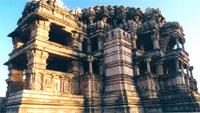 Sas
Bahu ka Mandir ('mother in law and daughter in law temples)- the two
graceful temples similar in style but different in sizes adjoining each
other were originally known as the 'Sahastrabahu' temples. Built in the
Nagara style of architecture, the twin temples dating between 9th and
11th century dedicated to Lord Vishnu or Sahastrabahu, stands close to
the eastern wall of the fort.
Sas
Bahu ka Mandir ('mother in law and daughter in law temples)- the two
graceful temples similar in style but different in sizes adjoining each
other were originally known as the 'Sahastrabahu' temples. Built in the
Nagara style of architecture, the twin temples dating between 9th and
11th century dedicated to Lord Vishnu or Sahastrabahu, stands close to
the eastern wall of the fort. 
