 Declared
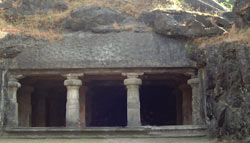
as a UNESCO World Heritage Site in1987, Elephanta caves located at Elephanta
Islands in Mumbai harbour contains some of the finest rock-cut sculpture
in India. A great tourist attraction, this island is located 11 km east,
across the Arabian sea from the Gateway
of India at Mumbai. Declared
as a UNESCO World Heritage Site in1987, Elephanta caves located at Elephanta
Islands in Mumbai harbour contains some of the finest rock-cut sculpture
in India. A great tourist attraction, this island is located 11 km east,
across the Arabian sea from the Gateway
of India at Mumbai.
Elephanta caves, the focal point of the Elephanta Island
is the glorious abode of Lord Shiva. There are altogether seven caves
spread on two hills, five on the Western hill and two on the Eastern hill.
The island originally known as Gharapuri (city of forts) was the
capital of Konkan Mauryas and was later re-named by the Portuguese. when
they captured Bombay from the Sultan of Gujarat in the16th century. The
island was named Elephanta after the colossal sculpted elephants found
there.
The magnificent rock cut temple complex dedicated to
Lord Shiva, was probably excavated during the 8th century by the Rashtrakuta
Dynasty which ruled the area from 757 to 973 AD. Cut out of a basalt rock
face, the cave complex covers an area of about 60,000 square feet and
has a collection of several subsidiary shrines, courtyards, halls
and porticos arranged in a splendid and precise mathematical symmetry
filled with exquisite stone sculptures of Hindu Gods and Goddesses. Stylistically,
the carvings in these caves combine the graceful forms of South Indian
Hindu sculpture with the exactness and poise of Buddhist Gupta Arts. Though
extensive damage have been caused to the sculptures by the Portuguese,
they are still remarkable.
The most important among the caves is Cave One on the
Western Hill. The main sculpture area of this large multicolumned hall
is on the southern wall at the back. Stairs lead to the main entrance
on the north of the cave complex with three openings supported by 28 decorative
pillars, each resting on a square base with fluted shafts. Eight of the
pillars have been destroyed or has collapsed. Facing the north entrance
there is a great manifestation of Lord Siva as Lord of the Universe ('Mahesvara
murthy' or 'Trimurthy') on the south wall at the back of the cave. The
6 m high idol is a magnificent one, considered to be a masterpiece of
Indian art. The three faces represent three aspects of Shiva: as the creator
(on the right), the preserver (in the center), and the destroyer (on the
left). The square linga shrine or the main shrine is at the western
end of the main hall in precise axis with the east entrance. Dwarapalas
(doorkeepers) guard each of its four doors originally accompanied by attendant
dwarfs (gana) which are largely missing now. The dwarpalas can be
traced back to the traditions of Buddhist Gupta arts. There is another
shrine on the east with sculptures of dwarapalas and lions guarding it.
Large scale scenes are deeply recessed into the walls
of the cave. The compositions depict different aspects of Shiva. There
is a much damaged carving of Lord Shiva seated on a lotus in yogic
posture as Lakulisa and on its right is a vigorously dancing Nataraja.
From the steps at the entrance, the yoni lingam, symbol of Shiva's creative
power can be seen. Shiva and Parvati playing dice, Ravana shaking
Kailasa (right) on which Shiva is seated, Panels spearing the Shiva killing
the demon Andhaka (left) and the marriage of Shiva and Parvati (right)
are positioned at the west end on the south wall. Behind Parvati stands
her father Himalaya and to his left is Chandramas, the god of the moon,
carrying a pot of soma (food of the gods). On Shiva's left is Vishnu and
below is Brahma.
|



 Monuments


