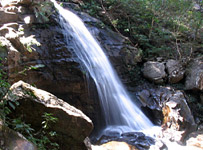
 Pachmarhi
situated on a large plateau ringed by hills on the evergreen central Satpura
ranges, is known as the Queen of Satpura for its spectacular beauty. The
hill station at a height 3550 ft. is located in Hoshangabad district,
Madhya Pradesh. The place is surrounded by low lying rugged hills, ravines,
beautiful forests, 12 breathtaking waterfalls, serene pools and quiet
glades. Pachmarhi
situated on a large plateau ringed by hills on the evergreen central Satpura
ranges, is known as the Queen of Satpura for its spectacular beauty. The
hill station at a height 3550 ft. is located in Hoshangabad district,
Madhya Pradesh. The place is surrounded by low lying rugged hills, ravines,
beautiful forests, 12 breathtaking waterfalls, serene pools and quiet
glades.
The saucer shaped valley of Pachmarhi, was discovered
by Captain James Forsyth of the Bengal Lancers in 1857, and was developed
as a sanatorium for the British troops. The point where he first sighted
the area, was named after him as Forsyth Point but later renamed as Priyadarshini
Point. The valley with its not too cold but pleasant weather served
as the summer capital of the central provinces during the British regime.
The Victorian churches, bungalows and cemeteries left behind bring back
remnants of the colonial past.
Besides its colonial atmosphere, the hill station has
archeological relevance as well as religious significance with its ancient
rock paintings in cave shelters seen in many locations of the region and
the famous Shiva shrine located in the Mahadeo Hills. The rock paintings
left behind are seen in different locations in the Satpura hills and the
earliest of them dates back to 10,000 BC. The name Pachmarhi itself is
derived from Panch- Marhi (five caves) believed to be the abode of
the Pandava brothers of the 'Mahabharata' fame, for sometime during their
exile. The valley which is home to tribal Gonds and Korkus has a maze
of forest tracks apt for pleasant treks. The national park at Pachmarhi
has dense forests and is home to the gaur, leopard, bear, bison and other
wild animals. The place has a number of interesting tourist spots located
at a short distance from each other. If you are not keen on walking,
hiring a jeep or scooter at the bus stand in Pachmarhi town, is the best
means of visiting the places.
Places to See in Pachmarhi
Jatasankar
Jatasankar is a sacred cave under a mass of loose boulders situated
1.5 km from the bus stand in Pachmarhi town. Nearly half the distance
to the cave can be covered on vehicle while the rest has to be covered
on foot. The 'samadhistha Shiva' under a natural formation that resembles
the hood of a giant serpent in the cool dark cave is a place of abiding
sanctity and the striking rock faces is a wonder of nature. The name 'Jatasankar'
itself is derived from a rock formation resembling the matted locks of
Lord Shiva. The cool waters of Jambu Dwip stream takes its source from
this cave. The overcasting little rocks, many of them hanging precariously
between the huge walls of rock cutting changes colour from green to golden
yellow when light reflects on them. The place has a serenity about
it which could attract tourists. On the way to Jatashankar, there is a
temple of lord Hanuman, in which the idol has been carved out of a piece
of rock. Very close to the Jata Shankar Shrine is the Harper's Cave,
so named because of one of its paintings depicting a man seated, playing
a harp.
Pandava Caves
Five ancient caves carved out of a low hillock. The name Pachmarhi
itself is derived from these Panch- Marhi (five caves) believed to
be the abode of the Pandava brothers of the 'Mahabharata' fame, for a
long period during their exile of 12 years. The cleanest, most airy
of them is known as 'Draupadi Kuti' and the dark one, the 'Bhim Kothari'.
Some motifs and a brick stupa were discovered above the caves. Archaeologist
claim that these caves must have been constructed by Buddhist monks during
the Gupta period, in the 9th or 10th century A.D. but the popular belief,
that the Pandavas had lived here, still continues.
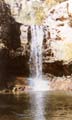 Apsara
Vihar (Fairy Pool) Apsara
Vihar (Fairy Pool)
By the side of the Pandava Caves a road leads to this spot which is accessible
only on foot. The pool is formed by a little fall which is nearly
30ft high The pool is an ideal place for swimming and diving. A
swimmer can reach under the fall after swimming the short distance of
the pool which gradually gets deeper near the fall. Others can enjoy
their dips in the shallow end of the pool.
Rajat Prapat (Big Fall)
It is situated nearly half a km towards east of Apsara Vihar. Those seeking
adventure will find it in this ten minute walk over rocks and boulders
from Apsara Vihar to the top of Rajat Pratap, the big Fall. The height
of the fall is nearly 350ft and it looks as if a strip of silver is gliding
through. It is rather difficult to descend and tough to reach near the
fall as it is nearly 3km and is very strenuous. Only adventurers and trekkers
can negotiate the path which goes round the hill on the left view of the
point.
Rajendra Giri
This hill fascinated late Dr. Rajendra Prasad, the first President of
India and is named after him. He visited this place a couple of times.
A very important person's beautiful house known as Ravi Shankar Bhavan
was constructed for his comfortable stay. A glimpse of the building can
be had from this hill. The beautiful scenery all around will enchant
you, particularly the three dominating peaks on the southern -western
crest of the valley.
Priyadarshini Point
Formerly known as Forsyth point, named after Captain James Forsyth
of the Bengal Lancers who discovered the valley in 1857, from this point.
The view from this point is spectacular especially at sunset, when the
three dominating peaks; Chauradeo to the left, Mahadeo in the centre and
Dhupgarh, the highest point in the Satpura ranges to the right; appear
glowing red and fiery in the setting sun against the purple background
of the sky.
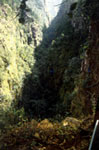 Handi
Kho Handi
Kho
The deepest ravine at Pachmarhi nearly 300ft deep. The ravine is densely
wooded with steep sides and the hum of water can be heard gushing far
below. Legend says that Lord Shiva imprisoned a large, evil snake which
actually was a demon and buried it in solid rock in this ravine. The local
natives used to call it Andhi Kho which later took its current name. There
is a clearing with a railing from where one can take a look at the ravine.
Mahadeo
The way to this holy centre for the Hindus, 10 km from the town is through
dense Sal forests with precarious hairpin bends and curves. The cave shrine
here, with a 100m walk to the entrance has a large 'shivling'. The inside
of the cave is cool with drops of water trickling from its roof. The trickling
water forms a holy depository in which the devotees can take a dip. There
is a legend behind the existence of this shrine. The evil demon Bhasmasur
undertook a long penance to please Shiva and was finally rewarded with
a boon that he could reduce any living creature to ashes by placing his
hand on its head. After obtaining the boon, the demon wanted to try it
out on Shiva himself. Shiva fled and thrust his head into the Mahadeo
caves. Lord Vishnu came to his rescue in the form of a beautiful damsel
and lured the demon to put his hand on his own head which resulted in
his destruction. The pond outside, by the side of the cave where the demon
is believed to be actually burnt to death is known as Bhasmasur Kund.
Mahadeo has been a centre of pilgrimage for the last many centuries. Since
time immemorial Hindus have been coming to Mahadeo to pay their homage
to Lord Shiva. Now a large fair is held on Shiva Ratri when nearly two
to three lakhs of people visit Mahadeo and nearby Chauragarh on this occasion.
There is Gupta Mahadeo, a narrow dark gully nearly 30 ft. formed by two
rocks. Inside there is a darshan of a natural 'shivalingam'.
 Chauragarh Chauragarh
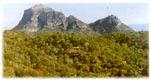
Chauragarh is a 4 km sheer climb with 1300 steps from Mahadeo. There is
a temple on the rectangular top with an idol of Lord Shiva. Ardent devotees
make the strenuous climb, sometimes carrying Triscends (Trishuls) on their
shoulders as an offering to Lord Shiva. This tradition is followed as
a mark of devotion, especially during Shivaratri.
The trishuls may be of differing weights some weighing up to three to
four quintals. There is a Dharmashala for relaxation.
 Bee
Fall Bee
Fall
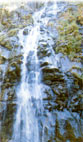
Situated only 3 km from the town, Bee fall ( now known as Jamuna Prapat
) is a spectacular fall in the stream which provides drinking water
to Pachmarhi. You can walk up the perilous road or hired Jeeps can take
you up to the place where you can have not only a glimpse of the fall
from above, but also the beautiful scenery as well. The bathing pools
here are very popular. There is half a kilometer pathway down to the fall.
An ideal place to spent a day with family and friends.
Reechhagarh
Reechhagarh is situated just one kilometer further off
the airstrip, on the right side of the main road. A half kilometre
walk takes one to the wonderful natural amphitheatre in rock, approached
by a semi dark and large open cave like entrance on the south side.
The large underlit structure of rocks looks like a great hall.
Dorothy Deep Rock Shelter ( Bhrant Neer)
These rock shelters are believed to be of 10th or 15th century B.C. with
pre-historic cave paintings. Excavated in 1930, they depict the scenes
of hunting, dancing and war and some of them are fully coloured. The spot
is less than an hours walk from the road. In the excavation carried out
years back, a skeleton of a human being measuring nearly seven feet was
found. Besides these rock- paintings, the place has a natural setting
and lyrical charm also.
Jalawataran (Duchess Falls)
The falls can be reached only on foot. The descent is steep and the trek
strenuous for almost all of the 4 km to the base of the fall's first cascade.
Sunder Kund (Saunder's Pool)
Crossing the stream below Duchess Fall and following a footpath about
2.5 km in a south- west direction about 35 min. walk, brings one to a
huge rocky pool that is excellent for a refreshing swim. The pool is very
deep and only excellent swimmers dare swim in it.
Irene Pool
This pool was discovered by Irene Bose, wife of Justice Vivian Bose,
and named after her. The route upstream leads to a cave, through which
the stream goes underground and then over a khud in a series of falls.
Dhoopgarh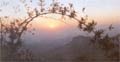
The highest point in the Satpura range, with a magnificent view of the
surrounding ranges. A very popular spot for viewing sunsets. There is
a 1000ft ascend from the road level if traveling on foot or riding a bicycle.
The peak 4429 ft. high from the sea level also called the Elephant can
be reached by road from the north side. The view is spectacular with the
mammoth rock formations reflecting the light in a variety of delicate
shades of purple and violet. There is a rest house here where you can
spend the night. Bookings can be done through the local P.W.D office.
Satpura National Park
Set up in 1981, Satpura National park is 524 sq.km in area. It spreads
to the west and north of Pachmarhi, through a dense forest of evergreen
sal, Teak and bamboo. The highest peak of Dhoopgarh and Mahadeo is located
here. This park is home to guar, bison, tiger, leopard, bear, four horned
deer, blue bull etc. and many colourful rare birds. The high peaks with
the deep valleys, rivulets, water falls and Tawa's vast reservoir combine
to give this park unique and breathtaking beauty. If you wish to spend
a day or night in the park, obtain the permission from the Director, National
Park office (Phone : 07578- 52130). There is the Churna Tourism
Bungalow which offers basic accommodation and food, and also the forest
bungalows at Bori and Dhain. The park also runs a museum called 'Vaniki
Sangralaya' at the Bison Lodge(1862), the first building that was constructed
in Pachmarhi by the British. It is advisable to take a four wheeler preferably
a jeep for the tour. The entrances are from Panarpani gate, which is close
to Pachmarhi to reach Neemghan or from the Rorighat end.
Catholic Church
Built in 1892 by the British, the Catholic Church is a blend of French
and Irish architecture. Its Belgium stained-glass win-dows add rare attraction
and beauty to the building. The Church has a cemetery attached to it and
graves date from 1859, World War I and II.
Christ Church
Build in 1875 by the British, the protestant Church's architecture
is fascinating; its 'sanctum-sanctorum' has a hemispherical dome on top
with its ribs ending with faces of angels. The stained-glass panes adoring
the walls and rear of the altar were imported from Europe. They present
a gorgeous view as sun rays pass through them.
|



 Hill Stations


