 In
the foothills of the Himalayas, overlooked by the white peaks of Kanchenjunga,
'Darjeeling' has been a popular hill station since the British established
it in the mid 19th century. Located in the northern extreme of the Indian
state of West
Bengal in Darjeeling district, the exotic town lies just east
of Nepal, south of Sikkim,
and a bit west and south of Bhutan. The town, also the headquarters of
Darjeeling district is situated 305 miles north of Kolkata and is perched
on the narrow Ghoom Senchal Ridge at an altitude of (7000ft), and
descends abruptly to the bed of the Great Rangit River. The hill station
presents the most spectacular views of the snow capped Himalayan peaks
including Mt.Everest and Kanchenjunga. In
the foothills of the Himalayas, overlooked by the white peaks of Kanchenjunga,
'Darjeeling' has been a popular hill station since the British established
it in the mid 19th century. Located in the northern extreme of the Indian
state of West
Bengal in Darjeeling district, the exotic town lies just east
of Nepal, south of Sikkim,
and a bit west and south of Bhutan. The town, also the headquarters of
Darjeeling district is situated 305 miles north of Kolkata and is perched
on the narrow Ghoom Senchal Ridge at an altitude of (7000ft), and
descends abruptly to the bed of the Great Rangit River. The hill station
presents the most spectacular views of the snow capped Himalayan peaks
including Mt.Everest and Kanchenjunga.
The name Darjeeling is derived from the Tibetan word
' Dorje Ling' (Place of the thunderbolt). According to legend, Darjeeling
was struck by a mystic thunderbolt of the Lamaist religion, said to be
the scepter of Indra, Lord of the Gods, which supposedly fell on the site
known as the observatory hill. In Sanskrit, the word 'Durjay Ling',
means 'Siva of invincible prowess, who rules the Himalayas'. Until the
beginning of the eighteenth century, Darjeeling belonged to the Rajas
of Sikkim, who lost their domain to invading tribes of Gurkhas from Nepal
in 1780. In 1828, two British officers Captain G.W.A.Lloyd and Mr. J.W
Grant stumbled on this remote Shangri-La and realized its potential as
a strategic link with Nepal and Tibet, as well as a hill station sanitarium.
On the direction of the then Governor General, Captain Lloyd negotiated
with the Raja Of Sikkim and in February 1835, Darjeeling 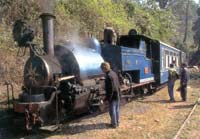 was
presented to the East India Company. It became a popular resort for the
British who wanted to escape from the sweltering heat of the plains. was
presented to the East India Company. It became a popular resort for the
British who wanted to escape from the sweltering heat of the plains.
Orange and Cardamom are two cash crops of this district.
Darjeeling peaks has steeply sloping conifer forests and terraced tea
plantations surrounded by around 4,000 types of flowering plants and 300
varieties of ferns, including the rare tree fern. Darjeeling tea
is famous throughout the world. During April - May, Magnolia and Rhododendron
flowers magnifies the charm of the valley. The town is occupied by
people from all over the eastern Himalayas who have come to work or trade
as well as Tibetan refugees. This fascinating place also has a number
of Buddhist monasteries and a considerable presence of visiting Buddhist
monks and Tibetan scholars.
Darjeeling has the unique attraction for its "Toy Train" which UNESCO
recognizes as a World Heritage Railway. This famous narrow gauge steam
railway makes its way from Siliguri -Kurseong in the plains up to Ghoom
and Darjeeling in the hills. Its slow speed (six to seven hours to cover
a distance of 82 kms) gives you enough time to watch and appreciate the
beauty which nature has provided. This train passes through the forests,
roaring rivers, over deep valleys and through mountains and tunnels. Darjeeling
is also a trekkers paradise and the Gorkha hill council has provided ample
trekking facilities for the adventure loving people.
Kanchenjunga
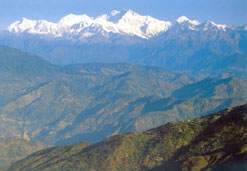 Located
in the Himalayas, Kanchenjunga is the third highest mountain peak in the
world. One of the most beautiful peaks it presents spectacular views from
various spots in Darjeeling. The best uninterrupted views are to be had
from Bhan Bhakta Sarani. Located
in the Himalayas, Kanchenjunga is the third highest mountain peak in the
world. One of the most beautiful peaks it presents spectacular views from
various spots in Darjeeling. The best uninterrupted views are to be had
from Bhan Bhakta Sarani.
Chowrastha or the mall is the heart of the town. In the
local dialect, Chowrastha means the place where four roads meet. Mall
road ascends to a hill lined with shops and there is a huge flat platform
surrounded by benches for people to sit and watch the Kanchenjunga standing
with all its might. A walk along the Mall Road provides a beautiful view
of the surrounding hills with rhododendrons in bloom during season.
Bhutia Busty Gompa
This colourful monastery, located near Chowrasta, originally was a
branch of the Nyingmap sect's Phodang Monastery in Sikkim. It was transferred
to Darjeeling in 1879. The shrine here originally stood on Observatory
Hill. The Gompa also has a library of Buddhist Texts which has a copy
of the Tibetan 'Book of the Dead'.
Observatory Hill (Mahakal Baba Ko Sthan)
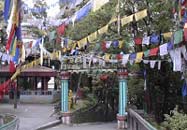 A
few minutes walk from the Mall Road leads to the Observatory Hill offering
a magnificent view point for the twin peaks of Kanchenjunga. The sacred
Mahakal temple is situated here. Mahakal is considered as the incarnation
of Lord Shiva. Adjacent to Mahakal temple is a Buddhist Shrine. This view
point is sacred to both Hindus and Buddhists and the Hill is thronged
by worshippers throughout the year. A
few minutes walk from the Mall Road leads to the Observatory Hill offering
a magnificent view point for the twin peaks of Kanchenjunga. The sacred
Mahakal temple is situated here. Mahakal is considered as the incarnation
of Lord Shiva. Adjacent to Mahakal temple is a Buddhist Shrine. This view
point is sacred to both Hindus and Buddhists and the Hill is thronged
by worshippers throughout the year.
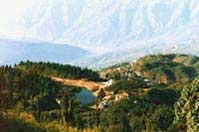 Tiger
hill and Senchal Lake Tiger
hill and Senchal Lake
Tiger Hill, about 11km from Darjeeling at 8,515 feet is famous for
its spectacular views at sunrise. The gold and orange vision of the peaks
on the horizon is worth watching. From Tiger Hill, the top of Mount Everest
is visible, peeping out through two other peaks Makalu and Kanchenjunga
standing by its side. The peak that looks highest is that of Makalu. The
trip to the summit of the hill is through Ghoom(7407 ft), the highest
railway station on the Darjeeling Hill Railway. Situated close to the
Tiger hill, the Senchal lake at 8031ft.supplies Darjeeling with its domestic
water. It is particularly a scenic area and popular as a picnic spot.
Ghoom Gompa
The Ghoom Gompa or Yogachoeling Gompa is the largest and most famous
monastery located 8km south of Darjeeling Town, just below Hill
Cart Road and the railway station near Ghoom. It was established in 1875
by a Mongolian astrologer-monk and contains a giant seated image of 'Maitreya
Buddha' surrounded by sticks of incense, bells, drums and ornate thanka
scrolls. Foreigners are allowed to enter the shrine and take photographs.
A small donation is customary and the monks are very friendly.
Other Gompas
There are three other gompas in Ghoom, the very large but relatively
uninteresting Samdenchoeling, the nearby and smaller Sakyachoeling and
the Phin Sotholing. Nearer Darjeeling, on Tenzing Norgay Road, there is
the Aloobari Monastery. The monks sell Tibetan and Sikkimese handicrafts
and religious objects here. There is a cottage next door for enquiries.
Halfway between Ghoom and Darjeeling is the Thupten Sangachoeling Gompa
at Dali. Westerners interested in Tibetan Buddhism can study here.
Dhirdham Temple
The Hindu temple in Darjeeling was erected by Dhir Shamsher Rana of
Nepal. Situated below the railway station, the shrine is modelled on the
famous Oashupatinath Temple in Kathmandu
 Himalayan
Mountaineering Institute and Museums (HMI) Himalayan
Mountaineering Institute and Museums (HMI)
Himalayan Mountaineering Institute located on the West Jawahar Rd,
was established after the conquest of Mt. Everest by Hillary and Tenzing.
Tenzing Norgay was the Director of the institute for many years and after
his death in 1986, was cremated near here. The institute conducts preliminary
course on Rock climbing on Tenzing Rock and Gombu Rocks which is situated
at Lebong Cart Road. Short films on mountaineering is also screened here.
The mountaineering museum here contains a collection of mountaineering
equipments including the ones that were used on that historic Tenzing
Hillary climbs; specimens of Himalayan flora and fauna and relief model
of the Himalaya. The Everest Museum next door traces the history of attempts
on the great peak. Open daily 9am to 5pm. Near by, there is an interesting
well manicured cemetery of former Raj residents.
Himalayan Zoological Park
The Himalayan Zoological Park (2km from the town) next to the
Mountaineering Institute is the only center in India for the captive breeding
of Snow Leopards. The Park houses a wide variety of animals and birds
some of which are Siberian tigers, Himalayan black bears, Yaks, Red Pandas
and the Llama of the Andes. Open daily from 8am to 4pm.
Lloyd's Botanical Gardens
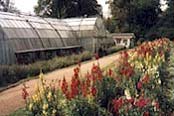 The
botanical garden near the market was laid out in 1865 by Mr.W. Lloyd.
It has an exotic and exclusive collection of a variety of Himalayan plants,
flowers and orchids. There are beautiful orchid hothouses containing over
thousands of species, Alpine flora including azaleas and rhododendrons,
magnolias and a representative collection of the flora of the Sikkim
Himalayas. The herbarium has rare botanical specimens. Closed Sunday and
bank holidays. Open 6an to 5pm.The Victoria Falls is a half an hour impressive
walk from the gardens. The
botanical garden near the market was laid out in 1865 by Mr.W. Lloyd.
It has an exotic and exclusive collection of a variety of Himalayan plants,
flowers and orchids. There are beautiful orchid hothouses containing over
thousands of species, Alpine flora including azaleas and rhododendrons,
magnolias and a representative collection of the flora of the Sikkim
Himalayas. The herbarium has rare botanical specimens. Closed Sunday and
bank holidays. Open 6an to 5pm.The Victoria Falls is a half an hour impressive
walk from the gardens.
Tibetan Refugee Self Help Center
Tibetan Refugee Self Help Center was established for the refugees
who had fled Tibet with the Dalai Lama after the Chinese invasion. Developed
in 1959, this center is a workshop for the manufacture of handicrafts
such as carpets, woolens, woodcarvings and leather work. These products
and a variety of Tibetan Curios are on sale and the sale proceeds are
shared by the Tibetan workers here. The center which has established itself
in the International scenario as a place for hard work, self esteem and
truth is very popular among the tourists.
Lebong Race Course
The Lebong Race Course, one of the world's smallest and highest
race courses, was laid out in 1885 as a parade ground. Situated at a distance
of about 8 km from the main town, the complete lap of the race course
is only 480 yards long. It is pleasant for walks.
Tea Gardens
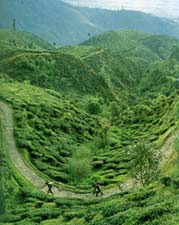 Darjeeling
is one of the world's most famous tea growing centers. Here plantations
were started in 1840's. The hill station is dotted with more than 70 tea
plantations. Some of the well known tea estates are Thurbo, Margarets
Hope, Castleton, Badamtam with a 14ft. bronze statue of the Buddha. The
garden closest to Darjeeling is the Happy Valley Tea Estate. Here one
can see the processing of the world famous Darjeeling tea. Open 8 am to
12am and 13 am to 16.30. Closed Sunday and Monday. Darjeeling
is one of the world's most famous tea growing centers. Here plantations
were started in 1840's. The hill station is dotted with more than 70 tea
plantations. Some of the well known tea estates are Thurbo, Margarets
Hope, Castleton, Badamtam with a 14ft. bronze statue of the Buddha. The
garden closest to Darjeeling is the Happy Valley Tea Estate. Here one
can see the processing of the world famous Darjeeling tea. Open 8 am to
12am and 13 am to 16.30. Closed Sunday and Monday.
Darjeeling Rangeet Valley Passenger Ropeway
Located at North Point about 3 km from the town, the ropeway covers a
distance of 8kms in 45minutes and connects the North point (7000 ft) to
the Singla Bazaar (800 ft). This was the first ropeway in India. The seats
in the rope way is limited and it is better to get the tickets in advance.
Timings 8am to 3.30pm.
Singhalila National Park and treks
Located about 20km from Darjeeling is Singhalila, the highest National
Park in West Bengal. Click
here for more details.
|



 Hill Stations


